
Palatine City Directory Shelves
Palatine city directory research begins at the Clayson House Museum, where the Palatine Historical Society keeps the local archive. The web inventory lists telephone books, Village and tri-town directories, regional books, neighborhood volumes, censuses, assessor records, maps, title abstracts, yearbooks, obituaries, and cemetery material. The runs are not continuous, so record both a successful page and the exact years checked without a match.
| Collection | Years | Where Held | Access |
|---|---|---|---|
| Palatine telephone books | 1910-1912 | Palatine Historical Society | Read during museum hours |
| Tri-town and Village runs | 1933-1953, with gaps | Palatine Historical Society | Physical archive |
| Illinois Bell scans | 1930 and 1940 | Illinois Digital Archives | Free online images |
| Paddock regional directories | 1966, 1968, 1969, 1971 | Palatine Historical Society | Physical books with phones |
| Local telephone books | Circa 1958, 1973, 1986, 1999-2007 | Palatine Historical Society | Noncontinuous local run |
| Winston Park Northwest directory | 1993 | Palatine Historical Society | Neighborhood-specific volume |
The Society lists missing tri-town books for 1927, 1929, and 1932. Those gaps call for neighboring repositories, regional directories, newspaper databases, and census records. No evidence supports claiming a complete annual run or a single final printed year.
Palatine Directory Books at Clayson
The Palatine Historical Society collections are housed at Clayson House Museum, 224 E Palatine Road. Listed hours are Tuesday 9:00-4:00, Thursday noon-4:00, and Sunday 1:00-4:00. Admission is free, the phone is 847-991-6460, and books may be read in the museum library. Staff can copy a page or two.
Ask by title, year, publisher, surname, and street. A useful request might pair the 1940 Village directory with the 1932-1950 township assessor books or the 1941 assessment list. The archive also has a card catalog, maps, street notes, church and school records, Palatine and Fremd yearbooks, obituaries, cemetery books, and Village minutes. These are separate evidence types, not interchangeable directories.
Note: The web inventory names collections, but it does not promise a page-level index or remote lookup for every volume.
Palatine Library Opens Other Indexes
The Palatine Public Library database list is the gateway to licensed genealogy and newspaper sources. Ancestry Library Edition is in-library only. FamilySearch, HeritageQuest, HeritageHub, Access Newspaper Archive, and regional newspaper databases offer other paths, with access rules varying by product. Daily Herald coverage is listed as 1901-current in the in-library archive and 1995-current in the remote collection.
The Main Library is at 700 N North Court and can be reached at 847-907-3600. The Rand Road Branch and North Hoffman Branch provide two more service points. A library board report says the library does not keep a special local-history collection. That distinction matters: use the library for databases and newspapers, then take Palatine-specific shelf questions to the Historical Society.
Repository tip. Save the database title, search terms, date range, image page, and access location so another researcher can repeat the search.
Digitized Palatine City Directories
Illinois Digital Archives supplies the clearest remote Palatine city directories. The June 1930 Illinois Bell volume was published by Reuben H. Donnelley, has 52 pages, and covers Wheeling, Arlington Heights, Palatine, and Mount Prospect. A September 1940 Illinois Bell directory covers the same four communities. Both are scans of dated publications, so cite the item, page, publisher, and directory date.
Open the digitized June 1930 directory before examining its captured page.
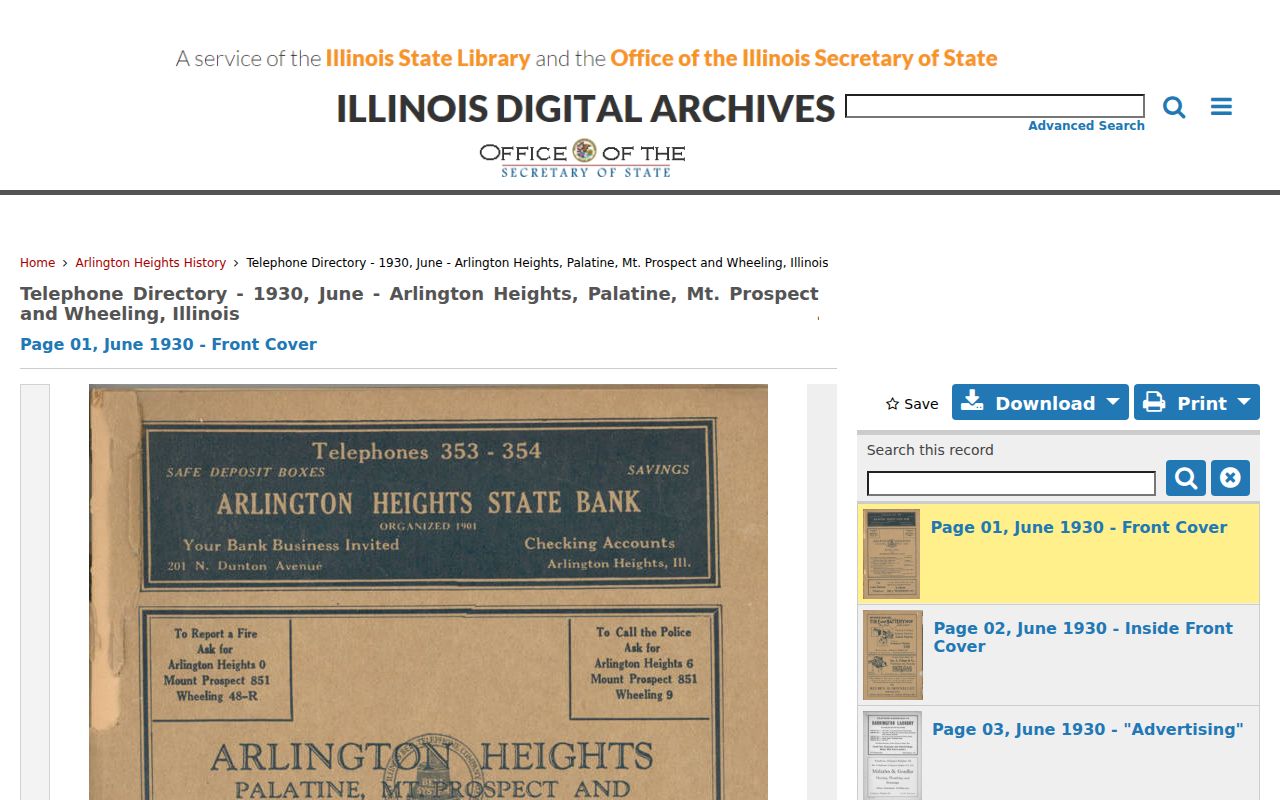
The image confirms the archive item and its scan interface. It is a period source, not a current resident listing.
Open the September 1940 telephone directory to compare a later decade.
The second scan creates a firm checkpoint between Village, census, and later regional directory evidence.
Palatine Directory Years in Sequence
The local archive charts a change from early telephone lists to village, civic, regional, and neighborhood publications. Publication purpose changed too, so a missing name can reflect the book’s scope rather than a person’s absence from Palatine.
| Year or Run | Directory Milestone |
|---|---|
| 1910-1912 | Earliest listed Palatine telephone directory run |
| 1930 | Digitized Illinois Bell volume creates an online bridge |
| 1933-1939 | Tri-town directory years in the Society inventory |
| 1940-1942 | Village of Palatine directory editions |
| 1948-1949 | Palanois Park directory with map |
| 1955 | Palatine, The Town of Homes civic and business directory |
| 1966-1971 | Paddock regional directories for Palatine, Rolling Meadows, and Inverness |
| 1993 | Winston Park Northwest neighborhood directory |
| 1999-2007 | Later local telephone books, annual completeness unstated |
Missing 1927, 1929, and 1932 tri-town editions are explicitly noted. Check Ela Area Library, nearby-community runs, and the IDA collections rather than filling those years by inference.
Decode a Palatine City Directory
Page 16 of the 1930 Illinois Bell volume shows how compact these listings are. Entries use initials, shortened street forms, an “r” before a residence, and a Palatine exchange number with letter suffixes. One line can connect a precise period spelling to an address, but it does not prove legal title, citizenship, or later occupancy.
| Name | Surname, given name, or initials exactly as printed |
|---|---|
| Residence mark | The 1930 page uses “r” before a residential address |
| Street | House number, direction, and shortened form such as “Plum Grv av” |
| Telephone | Palatine exchange and local number, sometimes with a letter suffix |
| Extra line | A professional or business listing may appear apart from the residence |
- Criss-cross directory
- A book or section arranged by street address or phone number instead of surname.
- Householder index
- An address-based list of the named person associated with a household at publication time.
- Abbreviation key
- The publisher’s legend for shortened streets, roles, and marks. Save it with every cited page.
A 1930 listing can reconnect a surname and street to a census, obituary, yearbook, title abstract, or house history. That is a family-history lead, not a claim that the name remains tied to the property.
Extend Palatine Directory Evidence
A city directory gives one dated snapshot. Federal census schedules released through 1950 can add age, birthplace, family structure, and other household facts. Palatine Historical Society township censuses and assessor books supply local checks. The Society’s Daily Herald index covers 1901-2019, while library newspaper tools reach both earlier and current material under their stated licenses.
Maps answer a different question. Library of Congress Sanborn coverage includes Palatine sheets for 1894, 1905, 1924, and a 1950-era update. They show street names, building footprints, uses, and construction context rather than people. The 1886 Snyder Cook County real-estate map adds landowner and parcel context. Pair the map date with the directory date before assuming two address forms refer to the same structure.
For a legal property chain, move from the printed address to a PIN or legal description and then to Cook County Clerk recordings. Modern address-keyed work is covered in the Palatine street directory.
Bridge Palatine Directory Gaps
An absent name has several possible causes. The resident may have moved, died, lacked listed telephone service, used initials, appeared under another surname form, or fallen outside that publisher’s coverage. A missing volume creates another kind of silence. State the negative-search scope instead of turning it into a conclusion.
Search surname variants, maiden and married forms, initials, OCR errors, and abbreviated streets. Then use yearbooks, church and cemetery books, obituaries, township or federal census, assessor lists, title abstracts, and deeds. The federal 1890 census loss and Cook County’s pre-October 1871 record destruction are real gaps, so local ledgers, newspapers, and archives may be the only bridge.
Note: “Not digitized,” “not found online,” “destroyed,” and “not public” describe different record conditions.
Trace Family in Palatine Directories
Build a chronology one source at a time. Keep the exact text, image page, date, repository, and limitation in every row. This protects against false joins when two Palatine residents share a surname or a road name changes form.
- Find the first verified listing and copy its spelling, street form, exchange number, volume date, and page.
- Check the prior and next available Palatine city directories, noting a move or a gap without guessing why.
- Ask whether the volume has a criss-cross section, then test the address and nearby entries.
- Pair a directory near 1930, 1940, or 1950 with the corresponding released census and local township material.
- Test the identity through an obituary, yearbook, cemetery, church, assessor, title, or deed record.
When a person disappears, search the next newspaper and obituary span, check a new address under the same name, and inspect relatives or spouse names only where the source states the relationship. A directory is strongest when its dated claim is confirmed by an independent record.