
Palatine Neighbor Record Sources
Begin with the source that matches the block question. Cook County maps show parcel relationships. Recording documents establish legal interests. Village permits date work at an address. Palatine associations and watch groups describe community areas, but do not publish a public list of every household. These distinctions keep a search for neighbors tied to facts.
| Source | What it shows about a block | Access |
|---|---|---|
| CookViewer | Adjacent parcels, PINs, addresses, classes, tax and district context | Free public map |
| Assessor and Property Tax Portal | Property and tax context for one parcel at a time | Free address or PIN search |
| Clerk recordings | Deeds, easements, plats, and other recorded links | Free index; some images or copies paid |
| Village permits | Dated project and inspection evidence | Portal, phone, or FOIA |
| Watch and association pages | Group names, boundaries, meetings, and contact routes | Public pages; no household roster |
| Historical directories and maps | Earlier street forms, listed households, and block layout | Historical Society, archives, libraries |
An owner is not always an occupant. A condo search can also return many property rows for one address. Record what each official card says, including its date, and do not turn a shared street or tax district into a personal relationship.
Map a Palatine Neighbor Block
CookViewer 3.1 is the practical bridge from one Palatine address to nearby parcels. It accepts addresses, intersections, and several PIN formats. A selected result opens Property Details, while the nearby-search tool works from a source parcel and radius. Map layers may appear only at certain zoom levels, so save the map date and search boundary.
- Normalize the source address and locate it with the Parcel Address Locator.
- Select the source parcel, then run nearby search with a small, stated radius.
- Record every adjacent PIN and address as a separate row, including condo or common-area results.
- Open each property card and preserve the township, city/ZIP, tax district, class, and status actually shown.
- Use a PIN in the Clerk index only when a deed, plat, easement, or other legal link matters.
That flow is address → source parcel → adjacent PINs → individual property cards → recorded documents. It describes the immediate block. For a complete named-street chain, use the Palatine Street Directory instead.
Read Palatine Parcel Context
Cook GIS reports a county system with more than 1.8 million parcels and over 12,000 miles of roadway centerlines. That scale helps explain why a neighbor lookup needs precise identifiers. CookViewer’s historical parcel layers run from 2000 to the present and can reveal geometry or tax-year changes around a Palatine block.
The parcel schema includes PIN formats, street address, city and ZIP, township, tax district, parcel class, assessed values, building data, school and park districts, and links to property records. Not every field proves the same thing. A school district shows service geography. A building class describes the parcel. Neither identifies every resident. Export tools can save CSV or XLSX results, but the source parcel, radius, layer year, and download date must travel with the file.
Palatine Neighborhood Watch Boundaries
The Village’s Neighborhood Watch program lists 40 established groups and says several thousand homes are represented. The group names are community labels, not parcel boundaries. The page does not provide a public household roster or a president-and-email directory.
The official program offers meeting and organization context. This successful manifest capture shows the public Watch information at its source.
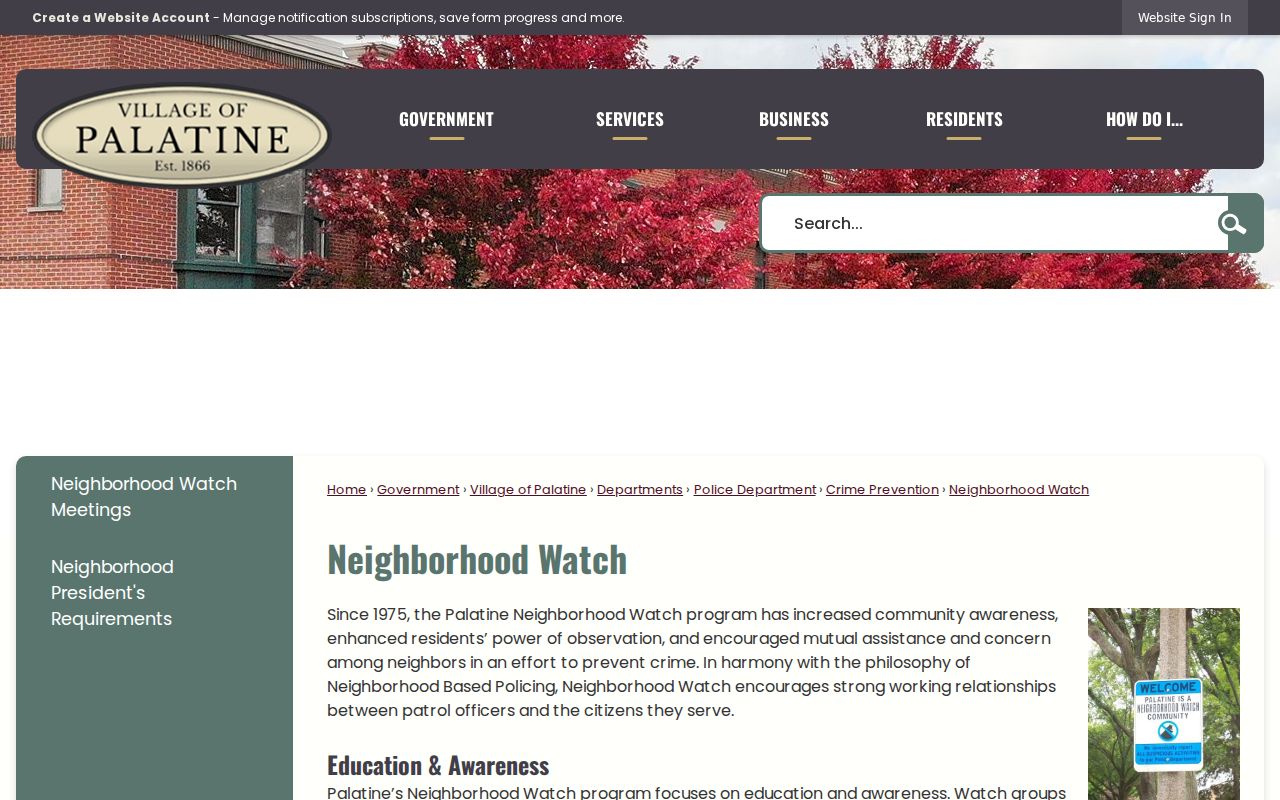
The image supports a route to a group, not a claim that each address within a named area participates. The separate meeting guidance can help residents understand how local groups gather without exposing private membership data.
Palatine Community Directory Layer
Associations add a useful layer after the parcels are known. The Palatine Chamber directory can be searched by keyword, category, or alphabet and includes a Homeowner Association/Property Management category. It is an organization directory, not a list of occupants. Two established association sites provide local maps, news, and contact paths.
Palatine Homeowners Association
The Palatine HOA site provides community information and an association contact route. Its coverage should not be assumed from a postal name alone.
Palatine Greens and Estates
The PGE Property Owners Association publishes neighborhood material and a map. Use that map for organization context, not proof of residency.
Palatine Chamber
The Chamber directory helps locate civic and property organizations by category. Listings concern organizations and businesses.
A block can share a street but fall across a group line. Save the association map date and compare it with CookViewer rather than merging the two boundaries.
Check Palatine Shared Projects
The Village’s active permit route covers permits after November 9, 2020 and points to Citizen Self-Service. Search nearby addresses separately. Similar dates can suggest a coordinated project or public improvement, but they do not establish that owners are related or that one contractor’s name is a resident.
If the portal fails, Palatine Building Permits and Inspections can be reached at 847-359-9042. An Illinois Freedom of Information Act request is another route for existing Village records. Ask for an address, date range, permit type, and electronic format. FOIA produces records the Village holds, subject to exemptions and redactions. It does not require staff to create a private block directory.
Note: Preserve the permit’s applicant role and date rather than treating every contact name as a Palatine neighbor.
Voter Data Is Not a Block List
Illinois offers an individual voter registration lookup that requires first name, last name, birth date, five-digit ZIP, then street number and street name. It is designed to confirm one voter’s registration and polling context. It does not expose a public Palatine roster by block.
Statewide voter-file disclosure is constrained by the Illinois Election Code, including 10 ILCS 5/1A-16 and related provisions. The research found no official public block-level voter list or neighborhood household export. A failed individual check can reflect spelling, ZIP, street format, eligibility, or privacy rules. It cannot prove that a person does not live nearby.
Compare Palatine Neighbor Tools
Official rolls and commercial neighbor tools are built for different purposes. The official path is slower, yet it states the custodian, field meaning, and date. Commercial products may blend old directory entries, marketing data, and inferred relationships without showing where each link began.
| Question | Official public source | Commercial category |
|---|---|---|
| Which parcels touch? | CookViewer geometry and nearby search | May use an unstated map or radius |
| Who holds title? | Assessor context plus Clerk recordings | May merge stale names |
| Which group serves the area? | Village and association maps | May infer a neighborhood from ZIP |
| Who occupies a home? | No complete public block roster located | May imply more certainty than its sources support |
Use the narrow official answer. A named owner, adjacent parcel, same association, and same ZIP are four separate relationships.
Older Palatine Neighbors by Address
Historical block work can add context that current parcels miss. The Palatine Historical Society holds a 1993 Winston Park Northwest Neighborhood Directory, Palanois Park material with a map, assessor books, street notes, and local directories. Digitized 1930 and 1940 telephone books, Sanborn sheets, and the 1886 landowner map provide dated layers.
A printed directory may list only phone subscribers. A current association can cover far more than one block. Keep the publisher, year, page, map source, and address spelling with every historical result. That makes it possible to describe how a Palatine block changed without implying that an old listing identifies today’s neighbors.
Protect Palatine Neighbor Privacy
Property maps do not disclose every renter, child, guest, or household member. Utility, delivery, and private contact data are not part of the public block method. Illinois FOIA permits redaction of private information and unwarranted invasions of personal privacy. The Attorney General’s Address Confidentiality Program supplies eligible survivors a substitute address, though official guidance says property records cannot always be shielded.
Lawful use. Palatine neighbor records may support civic curiosity, reconnection, and personal safety. Never use them to watch, intimidate, stalk, harass, or harm anyone.
If the purpose can be met through an association contact, public meeting, or a polite direct introduction, there is no need to assemble a personal profile. State the source and date, avoid relationship guesses, and respect a person’s choice not to engage.