
Palatine Previous-Resident Sources
No single Palatine record spans the full life of an address. Modern parcel tools establish the current PIN, deeds carry the legal chain, and local books add people who used the address. For older work, maps answer whether the same lot or building existed. The table is an era guide, not a claim that each run contains every Palatine street.
| Source | Years covered | Where held | What it shows |
|---|---|---|---|
| Cook Clerk recordings | Current index, earliest web year unstated | Clerk Recording System and counter | Deeds, parties, dates, PINs, legal descriptions |
| Maps and local records | 1855, 1866-1972, 1886, 1894-1950 | Palatine Historical Society and Library of Congress | Land divisions, street labels, footprints, civic actions |
| Phone and local directories | 1910-1912, 1930, 1933-1953, 1955-1971, 1973-2007 | Historical Society, Illinois Digital Archives, regional libraries | Names, addresses, phone listings, household continuity |
| Township assessment records | 1932-1950, plus 1941 and 1984 lists | Palatine Historical Society | Taxed person and property evidence |
| CookViewer history | 2000-current | Cook County GIS | Parcel geometry, tax years, district context |
| Active building permits | November 9, 2020-current | Village permit portal | Dated work and permit activity |
Start at the newest reliable point and move back. A current PIN helps bridge changed street forms. If the question concerns a person rather than title, add a directory or census checkpoint before drawing a conclusion about past residents.
Anchor Palatine History to a PIN
The Cook County Assessor address search accepts a house number, street name, city, optional direction, and optional unit. Enter the street name without “Ave.,” “St.,” or “Pl.” The form does not promise a simple owner-name lookup. Use it to establish the parcel and its 14-digit PIN, then carry that identifier into recordings and maps.
A PIN is stronger than a modern address alone. Old directories may abbreviate Plum Grove as “Plum Grv,” a deed can depend on a legal description, and a moved structure can outlive its original parcel context. Keep the situs address, meaning the physical parcel location, separate from any mailing address shown elsewhere. Record the legal description and PIN exactly.
Note: A “no result” from one spelling does not prove that the Palatine parcel or earlier address never existed.
Walk Back Palatine Deed Records
The Cook County Clerk Recording System is the legal spine for previous residents when the real question is past ownership. Its broad search accepts a PIN, document number, or combinations of names and address terms. The advanced form separates grantor and grantee roles and allows document-type and recorded-date filters. The current notice says the index is updated through August 6, 2026, but it does not state the earliest online year. Ask the Clerk or use the counter when the trail passes beyond web coverage.
- Find the current PIN and legal description through the Assessor or CookViewer.
- Search that PIN for the newest transfer document, then save its document number, parties, date, and legal text.
- Take the seller, the grantor, and search that person as a grantee to locate the earlier purchase.
- Repeat by date. Follow associated document numbers, subdivision, lot, block, and section-township-range when names vary.
- For an older gap, contact the current Clerk recording office and preserve the exact failed criteria.
- Grantor and grantee
- The grantor gives an interest; the grantee receives it.
- Chain of title
- The dated sequence of recorded interests tied to the same land.
- Legal description
- The formal description of the land, often more stable than a street address.
A mortgage, release, easement, plat, correction, trust deed, quitclaim, or transfer-on-death instrument is not automatically a sale. Label each document by its real role. Images or copies may cost money, while index searching is free.
Read the Palatine Recording Screen
The manifest’s successful capture comes from the Clerk’s advanced grantor and grantee search. It shows why a role-based search is more useful than typing a common surname into one broad box.
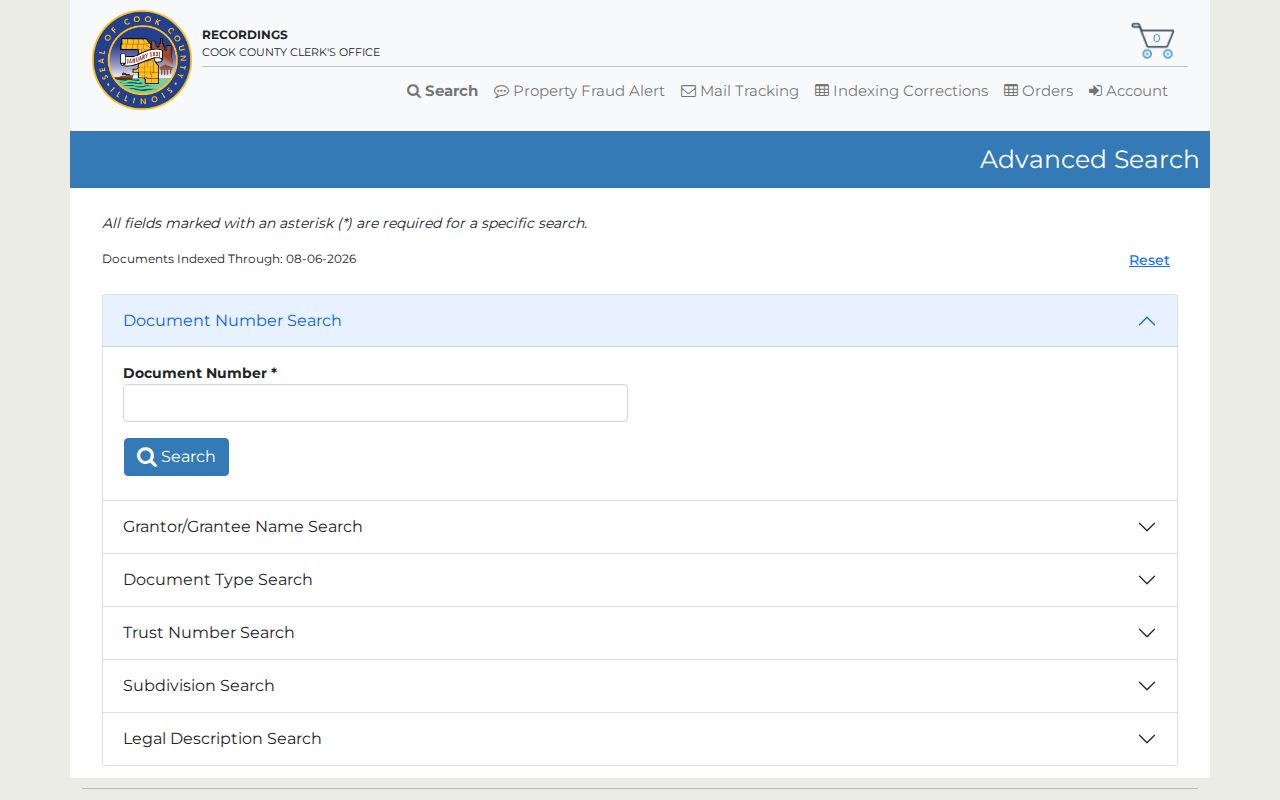
The displayed controls support name role, document type, and recorded-date limits. Save the query as part of the evidence matrix. A negative result has meaning only when the spelling, role, date span, and record type are known.
Test the Palatine Building
Ownership history and structure history can split. The Homes of Palatine collection includes street-indexed house histories, while the Library of Congress Sanborn volume gives Palatine building footprints and street labels across 1894 through later sheets noted in the local holdings. The 1886 Cook County real-estate map adds earlier landowner and parcel context.
Palatine’s Whipple and Stroker house stories show why this test matters. Buildings or pieces of buildings moved, so the life of a structure may not match one modern parcel. Follow two lines in parallel: the land through deeds and PIN evidence, and the building through maps, permits, photographs, and house-history notes. Treat a Historical Society narrative as a lead, then verify the legal claim in a recorded instrument.
Connect Palatine Past Households
Owners are only part of the answer. Phone books and local directories may place a subscriber or resident at an address, while census schedules can show a household at a dated checkpoint. The digitized June 1930 telephone directory supplies a useful bridge between a surname, a printed street form, and later Palatine records. It should never be treated as a current list.
- Copy the directory year, publisher, page, exact name, address form, and phone exchange.
- Check the nearest public census year and identify the correct enumeration area from maps, not from the surname alone.
- Compare the household with the 1932-1950 township assessor books or the next local directory checkpoint.
- Use an obituary, cemetery book, probate file, yearbook, or church source to resolve dates and relationships.
The full volume runs and reading method belong on the Palatine Directory Book page. For the backward-address task, capture only the entries tied to the property and state what each proves. Absence from a phone book may mean no subscription, a missing page, or a coverage gap.
Build a Palatine Evidence Matrix
A date-by-date worksheet keeps owners and occupants from blending together. Give each source one row with the date, exact address spelling, named person, role, PIN or legal description, document or page, and limitation. A useful series might move from a map footprint to a phone listing, assessor book, deed, permit, and modern parcel layer. Each row answers a narrower question.
| Field | What to preserve |
|---|---|
| Identity | Name as printed, variants, and role such as owner, occupant, applicant, grantor, or grantee |
| Place | Street form, city/ZIP, PIN, lot/block, and legal description |
| Time | Publication, execution, recording, assessment, or permit date |
| Proof | Repository, volume/page, document number, image status, and search limits |
This method also exposes gaps. A changed surname, unindexed deed, altered parcel, or missing directory year is a reason to change sources, not to fill the blank with a guess.
Palatine Archives Fill Web Gaps
The Palatine Historical Society archives hold title abstracts, deeds, township census material, assessor books, directories, maps, minutes, newspapers, yearbooks, cemetery records, and obituary material. Its 1855 Joel Wood subdivision reference and the title abstracts associated with local addresses can push a trail earlier than an online parcel view.
The Palatine Public Library supplies newspaper and genealogy databases rather than claiming a dedicated local-history collection. Regional directories at Ela Area Library, Illinois Digital Archives, and nearby communities can bridge missing Palatine years. For older Cook County probate, court, and naturalization records, use the Illinois Regional Archives Depository and Cook Circuit Archives. When a legal answer is needed, end with the Clerk’s image or certified-copy route.
Use Previous-Resident Records Carefully
A deed identifies parties to an instrument, not everyone who slept at the address. A tax record concerns a parcel. A directory lists according to the publisher’s rules. A permit records an application or inspection. Keep those meanings intact when naming previous residents. For family history, an obituary or census can add human context, but it should be cited with its date and access limits.
Lawful use. Palatine house-history records are for family research, title questions, and personal curiosity. Illinois law does not permit stalking, harassment, intimidation, or harm.
The Illinois Address Confidentiality Program can provide an eligible survivor a substitute address, though official guidance warns that it cannot ensure confidentiality in property records. Respect redactions and restricted records. Do not infer a living person’s present location from an old directory or deed.