
Walk a Palatine Street Directory
Start with one complete address, not a person’s name. A current Palatine address can be normalized in CookViewer, tied to a Property Index Number, or PIN, and then carried into the Assessor, Property Tax Portal, and recording index. Each source answers a different question. The map identifies a parcel; the tax and assessor records describe it; a deed identifies parties to a legal instrument. None is a complete list of everyone inside a home.
The street-by-street method works best as a chain. Save the date and exact spelling returned at each stop. When a source produces no match, try the documented fallback instead of treating silence as proof that no parcel, record, or resident exists.
- Enter the address in CookViewer. Save the normalized city, ZIP, map point, and PIN.
- Check the same location in the Cook County Assessor address search and Property Tax Portal.
- Use the PIN in the Cook County Clerk recording search, then inspect deed dates, parties, and associated documents.
- Check Palatine permits and use the Illinois voter lookup only when the required person, birth date, ZIP, and street facts are already known.
- For older occupants, move to the Historical Society’s telephone, village, and regional directories, then confirm with maps, assessor books, or deeds.
Normalize Palatine Street Addresses
Official tools do not accept one shared address format. The Assessor requires house number, street name, city, and a CAPTCHA, but its street field omits suffixes such as Ave., St., and Pl. The Property Tax Portal requires house number, street, and city, allows unit and ZIP, and warns against direction words and street abbreviations. CookViewer accepts a standard address, intersection, or several PIN formats. The Palatine Community Portal begins with one “Enter Street Address” field.
Older books add another layer. The 1930 Illinois Bell volume shortens Plum Grove to “Plum Grv” and Palatine Avenue to “Palatine av.” Keep the printed form beside the modern form. The county locator returned a score-100 normalization of the Village Hall address as 200 E WOOD ST, PALATINE, IL 60067, showing how a long form can be reduced without changing its place.
Note: A postal Palatine address does not by itself prove that the parcel is inside the Village boundary.
Palatine Street Search Fields
The Cook County Assessor is an address and PIN search, not a simple public owner-name box. Its advanced form adds applicant, attorney, appeal, township, year, and property-class filters. For a street directory search, the primary address form gives the cleanest starting point.
| Field | Required | Format | Use |
|---|---|---|---|
| House Number | Yes | Number | Fixes the point on a Palatine street |
| Direction | No | N, S, E, W, NE, NW | Separates similar road segments |
| Unit | No | Text | Helps with multi-unit property |
| Street Name | Yes | Name only, no suffix | Matches the Assessor convention |
| City | Yes | Municipality | Distinguishes postal and tax context |
| PIN | Separate route | 14 digits | Stable bridge to county records |
Open the Assessor advanced search before viewing its captured interface below. The image shows the actual county form rather than a recreated search box.
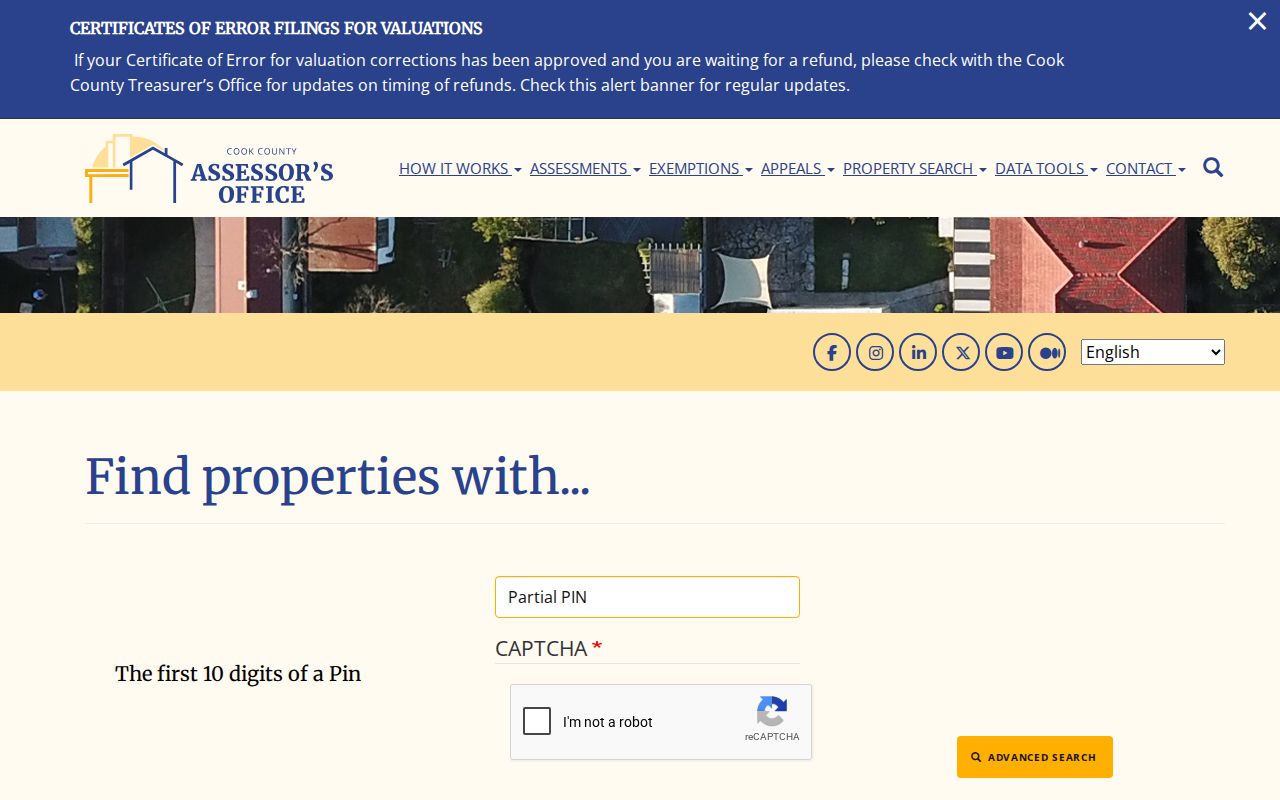
The form’s appeal and applicant fields can support a dated property inquiry, but they should not be presented as a current resident list.
Map Palatine Streets in CookViewer
CookViewer offers All, Parcel, PIN, Parcel Address Locator, and Address Locator modes. A result opens a Property Results panel, zooms to the map, and reveals Property Details when the parcel is selected. Searches accept 10-digit, 14-digit, and dashed PINs as well as an address or intersection. Condominium land can return more than one feature, so record each PIN rather than merging units.
Its nearby search, comparison, map report, CSV or XLSX export, and annual historical parcel layers from 2000 forward make it the strongest modern tool for walking a Palatine street. Cook County reports more than 1.8 million parcels and over 12,000 roadway-centerline miles in the full county system. Those figures explain why a clean PIN is more dependable than a broad name query.
- Parcel
- A mapped unit of land recorded for tax and legal purposes.
- Situs address
- The physical location assigned to property, which may differ from an owner’s mailing address.
- PIN
- The Property Index Number used to connect tax, map, and recording records.
- Plat
- A recorded drawing that defines lots, blocks, streets, or a subdivision.
Palatine Records Organized by Street
No official Palatine street directory contains every occupant. Use a coverage matrix to state what each record actually proves and where the gaps begin.
| Address Record | Custodian | Evidence | Coverage and Access |
|---|---|---|---|
| Parcel map | Cook County GIS | Address, PIN, geometry, districts | Free; historical layers 2000-current |
| Tax/property summary | Cook County property offices | Description, tax history, document links | Free portal; five-year tax view |
| Recorded instruments | Cook County Clerk | Grantor, grantee, deed type, legal description | Free index; images or copies may cost |
| Building permits | Village of Palatine | Dated project or inspection record | Portal after November 9, 2020; older records by office or FOIA |
| Voter confirmation | Illinois State Board of Elections | Current individual registration result | Name, birth date, ZIP, and street confirmation required |
| Historical directories | Palatine Historical Society and IDA | Period name, address, phone clue | 1910-2007 with gaps; selected 1930 and 1940 scans online |
The PIN joins the map to tax and deed evidence. A street name joins permits, voter confirmation, and directory pages, but each must retain its own date and source role.
Carry a Palatine PIN to Deeds
The Cook County Clerk assumed the former Recorder of Deeds duties on December 7, 2020. Current searches belong in the Clerk Recording System. Its own tips call the PIN the best search key and accept dashed or 14-digit forms. Results can display document number, recorded and executed dates, document type, first grantor and grantee, an associated document number, and the first PIN.
Grantor means the party transferring an interest; grantee means the receiving party. Follow an associated number or earlier grantor to move through a deed chain. Keep the legal description separate from the display address. The current notice says documents are indexed through August 6, 2026, but it does not state the first online year. Some plats, annexations, easements, declarations, and similar records must be obtained downtown.
Online index searching is free. Image and copy access follows the Clerk’s payment process. If the portal fails, preserve the PIN, legal description, party roles, document type, and date, then use the Clerk counter or mail route.
Date Palatine Street Changes
Palatine’s active permit page sends searches after November 9, 2020 to Citizen Self-Service. The portal covers current permit, plan, and license areas, while the official guides show dashboards and application records. Exact public result fields were not fully captured, so an applicant or contractor name should be quoted only when a live record displays it.
View the Palatine permit portal before the captured screen below.
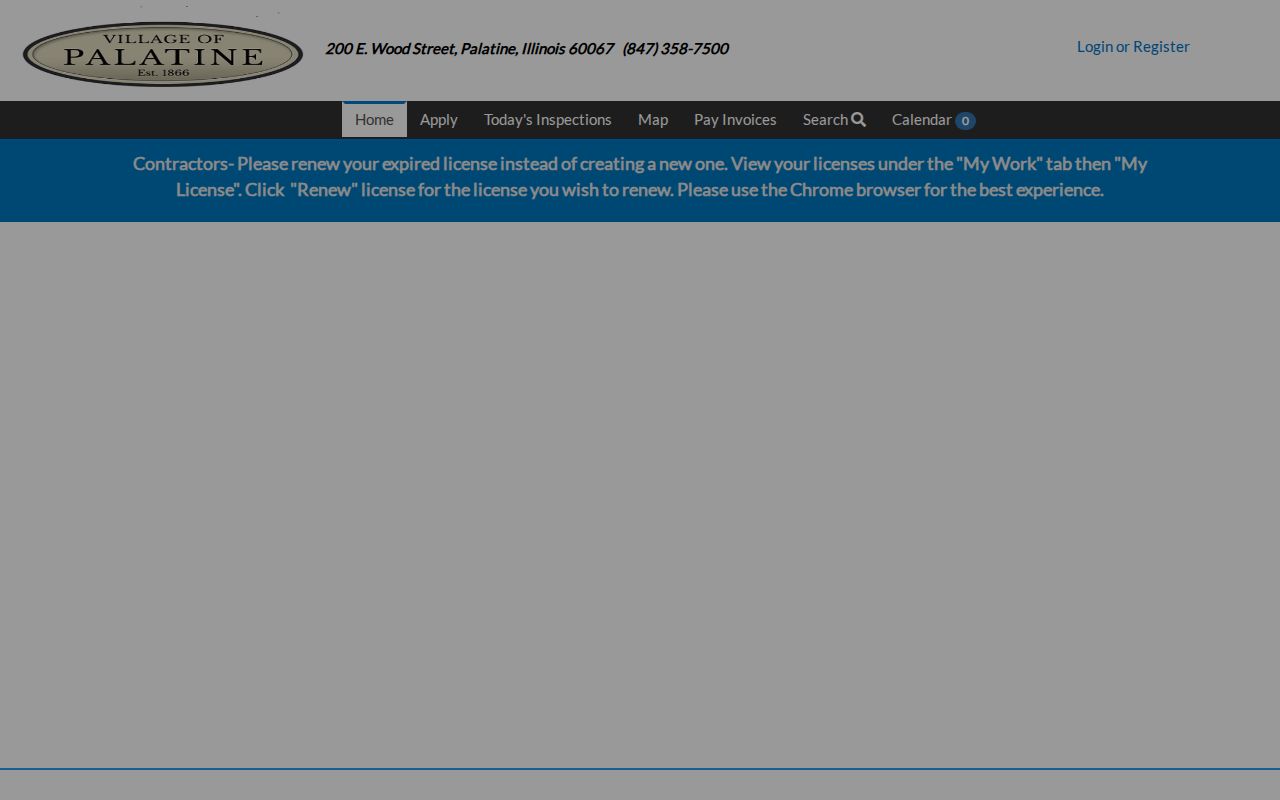
The screen identifies the official access point. For an older permit, contact Building Permits and Inspections at 847-359-9042 or submit a Village FOIA request for existing records by address, date range, and permit type.
Read Older Palatine Street Forms
The Palatine Historical Society holds street notes, telephone and village directories, township assessor books from 1932-1950, assessment lists from 1941 and 1984, title abstracts, maps, deeds, and the street-indexed Homes of Palatine collection. These sources are the bridge when modern parcel language does not match an old book.
A criss-cross directory is arranged by street or telephone number instead of only by surname. Ask the Society whether a specific Paddock or phone volume contains a reverse section. Its local runs begin with 1910-1912 telephone books, cross tri-town and Village volumes in the 1930s and 1940s, and continue in noncontinuous local books through 2007. The full collection method belongs on the Palatine directory book page.
Buildings complicate this work. Society histories describe an 1866 Whipple house moved to 303 N Brockway and parts of the Stroker house moved to two Plum Grove addresses. Track the structure and parcel on separate timelines. A current map point cannot tell that story alone.
Confirm a Palatine Voter Address
The Illinois voter registration lookup takes first name, last name, birth date, and a five-digit ZIP before loading street number and street name. It is an individual confirmation tool, not a way to download a Palatine street roster. A positive result shows current registration evidence for the query date, not ownership or everyone in a home.
When the street list does not load, save the ZIP, number, spelling, and lookup date, then contact the election authority. Illinois Election Code limits disclosure and use of statewide voter-file data. Keep the result in its narrow role and never merge it into an inferred household list.
Note: A voter match, deed party, permit contact, and directory listing describe four different relationships to one address.
Limits of Palatine Street Directories
A parcel card is not an occupant record. A deed party may have transferred an interest without living at the site. A permit identifies a dated project role. Voter lookup confirms only the individual query allowed by the official form. Old telephone books omit people without listed service, and a historical “r” notation establishes only a period residence listing.
Motor-vehicle address data is restricted by federal law, and public records may redact private information under Illinois FOIA. The Illinois Address Confidentiality Program supplies an eligible survivor with a substitute address, although official guidance says it cannot ensure secrecy in property records. No official public roster of every person on a Palatine block was found.
Lawful use. Use Palatine address records for legitimate personal, family, property, and civic research. Stalking, harassment, intimidation, or harm is prohibited.